Monday, January 7, 2019

Islam, Makkah and Non Muslims


Why Non-Musims are not Allowed into Makkah( Mecca)


Mecca is the holiest place of Islam but non Muslims are not allowed there

Mecca and Entry of Non-Muslims


Makkah is the transliteration of the Arabic name for Mecca. It is the holiest city for all Muslims and has roots that extend to the 5th century. The city was always a center of worship and, before Muhammad, Arabian pagan tribes venerated the place. Their most important pagan deity was Hubel, which remained till the 7th century. The pagan tribes congregated once a year in Makkah to pray at their shrine.

This was an annual pilgrimage and later perhaps Muhammad borrowed this concept for the Hajj, annual pilgrimage for Muslims. With the advent of Muhammad in the beginning of the 7th century and the foundation of Islam, the city was attacked in 628. At that time, the rulers of Mecca stopped Muhammad but later they agreed and signed the Treaty of Hudaybiyyah, which permitted Muslims entry into Mecca. But the treaty appears not to have been followed in letter and spirit and, in 630 AD, Muhammad, now at the head of a force of10,000, again attacked Makkah. He was successful this time, and the city surrendered to Muhammad.

The important point to note here is that the pagans had always recognized Mecca as a holy place and Muhammad also declared Makkah as a holy place. He declared it to be a center of Muslim pilgrimage. At that time Muhammad still anticipated that there would be threats to his rule and he wished to insure that no revisionist doctrine should again enter Mecca. To understand this, one has to look at the political and social atmosphere in Arabia at that time. All the tribes had not accepted Muhammad as their master or converted to Islam. To guard against any revisionist attempt, Muhammad decreed that no non-Muslim would be allowed to enter Makkah. This edict must be understood in the historical context of that period. Islam was still a fledgling religion and had as yet not spread its wings, and this was one of the methods Muhammad adopted to stop any threat to Islam and him. History records that there was lot of opposition to him. He decreed that no non-Muslim would be allowed to enter Mecca, on pain of death.

Muhammad also incorporated this injunction in the Koran in the Quranic verse “O believers, polytheists are not except ..., so let them not approach the sacred Mosque after this year of theirs.” (9-28) This verse has become the cornerstone of Islamic philosophy and, as Koran is considered the word of God, the literal interpretation has remained in force for the last 1300 years. One can rationalize and say that in other religions no such injunction exists regarding visiting their holy place, but Islam is different and has its own ethos.

Thus the injunction that non Muslims are forbidden entry to Mecca stands. It is worthwhile to note that Abu Hanifa, who represents the largest judicial school of Islam, has stated that non-Muslims can enter Makkah so long as they do not enter for Hajj or Umra. But the Saudi government, going by the Wahhabi interpretation of Islam, has banned entry of non-Muslims to Mecca. Thus, so long as the Wahhabi law is followed and the Saudi dynasty reigns, non- Muslims will never be allowed in Makkah. The Wahhabi school draw their inspiration from the Koran, which they feel is the word of God and thus sacrosanct.

Tuesday, January 1, 2019

British Rule in India ; A perspective. Was it good or bad?

Many Indians are apt to dismiss the Raj as an aberration that brought little good to the country. They opine that the British milked India dry for their benefit and left only by compulsion. To an extant this may be true but there were benefits from British Raj that just cannot be dismissed out of hand.
Firstly when the British came to India the Hindus were an oppressed lot and paid obeisance to the Islamic rulers. The jizzia tax was imposed on Hindus and to profess their religion they had to pay this tax in their own land. Despite all talks by some Historians who really are pseudo secularists the Muslim rulers were aliens who came from Central Asia and they ruled with an Iron hand. They did adopt local customs but mass scale conversions were the order of the day coupled with destruction of Hindu temples.
One great advantage of the British raj was that the Hindus became equals of the Muslims and the tag of a second class citizen was gone. The Hindus could now live and breathe with ease. They could worship their Gods and the Jizzia tax became a foot note in history. The Hindus took full advantage of this and developed far more than the Muslims who steeped in iconoclast ideas just lost their moorings and fell way behind Hindus in the fields of education and commerce.
There is also no doubt that the Hindus had fallen prey to obscure and abhorrent practices. The Hindu religion over a period of time had become rigid and practices like child marriage, sati-burning of the wife on the husband's pyre, caste system and thuggery crept in. It took an enlightened British rule to take on these abhorrent practices head on and cleanse India as never before.
The Raj was a period when law and order were restored in India and for once in a thousand years the people could live and work freely. For the English rule was not a terror and a lot many Englishmen came to India with zeal, mission, and love with the task of preserving the ancient Indian heritage. Thus the famous temples of Khujaraho and creation of the infrastructure for development like roads and railway cannot be wished away.
The Raj gave to India a framework of a civil administration to govern this vast country. They set up all India services and brought in the railways and postal services that benefitted the common man. India slowly started moving forward under the British raj.
The British were the rulers and the 'bada sahibs' and lived a royal life. But from the tea gardens of Assam to the cotton mills of Ahmadabad the British mark of development cannot be minimized.
Lastly, the Raj gave something that can never be forgotten. They brought in the concept of India as a nation. In two thousand years of Indian history, it was only the English who united India under one rule from the Khyber to the tribal areas in the northeast. It had never happened before as even the empires of Asoka and Aurangzeb never encompassed the entire subcontinent.
With the advent of the twenty-first century, we can look back to the period of British rule as a romantic period and sigh of relief that the British colonized Indian and not the French or Germans or Belgians. They created India and for this, the British rule has to be appreciated as something good for India.


Saturday, December 15, 2018

Barnard of Clairvaux and his poem "Song of Songs"- a lusty poem on Sex


Introduction
Poetry many a time gives a gloss to sex. A veneer that hides the real meaning. This was more so in the medieval age when sex was not so open as today, particularly in Europe which with the advent of Christianity was caged in a wall of puritanism. Ancient India was way ahead and what America is today, India was miles ahead at that age. India appreciated art and sex and enmeshed them together. It was not so in Europe and during the medieval age a poem titled " Song of Songs" was written. Theoretically, this poem refers to the love between God and the soul. Poems in that period had to bring in God so that the church did not come down heavily on the poet. This poem expresses love between the soul and God. It gives an analogy of this love like between the love of a bride and bridegroom.  The poem eulogizes the love of the soul and God and compares it to the most intimate moments of carnal love between a bride and a bridegroom on a nuptial night.
The composer of this poem was Barnard of Clairvaux.
Who was he? He was a French Abbot and a reformer of the Cistercian order. Barnard wrote this poem in an inspirational mood and today it is a poem that draws the greatest attention for the latent meaning of love. Barnard could not finish his work and died just when he was beginning the 3rd chapter. Never the less the poem arouses great expectation and is considered a work of art.
The Song and Lusty Sex
The song created ripples in the art world in the 19th and 20th century when the renaissance movement of reality was ushered in. People began to read it as a lusty celebration of human carnal desire. There are hints and clues and reading the poem will bring a reader to the depth of the soul. The poem alludes to the sex acts of the Shulammite women with Solomon. By Shulammite, the writer refers to the women of Jerusalem and the acts of pleasure with Solomon who was the ruler.I may point out that this was the period of the orgy and the Pagan dance made immortal in the movie "Solomon and Sheba".
The poem or song presents carnal intercourse as a mystery, as well as an obsession. In modern times the mystery has gone, but the obsession has remained. Now all are aware that sex is a clash of bodies and exchange of fluids. There is no magic in it, but the song presents this as a mystery. It represents the mood at that time which was Puritan.
All said and done the song is however an exponent of lusty sex, albeit hidden in the love of God for the soul of man.  Probably if this song were written today, like the poetry of Iris Murdoch the verses would have been more open and god may perhaps not have figured.
The song is great literature and it also teaches a lot. If I may add this song is the essence of erotic literature. The message of the song is that the body when in the act of love is all powerful and the center of everything. The song brings out the power of a physical union as Solomon who is the lover throws away everything in the world to just love his bride. The poem says that Solomon loves deeply and he discovers and gets a glorious insight into the soul inside his bride. This theme is the beauty of the song and gives the song an eternal look and feel. As per the poet, the strength of love (physical) is greater than the forces of death.
Allusions to God
The poem repeatedly brings in God or alludes to him.  These verses are certainly not for the puritan for God in his wisdom invites his beloved to the "house of wine". All around are forests, orchards, and figures in temples. What a lovely scenario. One is almost reminded of the Indian temples of Khujaraho, with nude carvings in the most explicit depictions. Wine adds impetus to the act of carnal knowledge and God is pleased. The poem brings out the power of carnal knowledge disguised as a reference to god.
The song brings out the fact that sex is something deeper and in that respect, Christianity was way behind Hindu tantra and philosophy, which accepted sex as a path to salvation or moksha. The Puritan church in Europe would not allow it and so we have this charade of the love of god for the soul. The song is a great way to have a fantasy and reading it with a beloved with a glass of wine is an afternoon well spent.
Last Word
The poem is also a great study of human nature, of passion and desire. These are the qualities that must be allowed to flower and not suppressed. The song plays a central role in fertilizing the imagination which in the main is sexual in nature. For there is no doubt that a physical union is the greatest way to be liberated and that is where Tantra comes in. 
I will close by writing and recommending all to read this song. It is archaic English, but in the company of a girl who understands the language, it can be a great and elevating experience.

Saturday, December 1, 2018

John Wayne; Star Par Excellence

  • Hollywood Films
  •  
  • Cowboy films
  •  
  • Westerns
 th 5
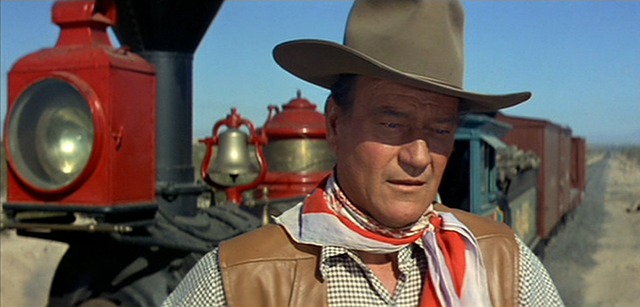
I was a small boy when John Wayne died in 1979. But even at that age  I loved the films of John Wayne and watched them in cinema halls with my friends while playing truant from school. Later,  I built up a collection of his films and have now over 90 of his films on my hard disk. For me there is no bigger star of cowboy films than John Wayne. Maybe Clint Eastwood would come a close second, but Wayne was the original macho star.
I saw his movie in a morning show in 1985 or 86  titled "True Grit". In this movie, he plays an aging one-eyed Marshal and the best scene is when he goes at the outlaws with the horse's reins clenched in his mouth and both guns firing at the outlaws. It was a great shot and I am so glad that John Wayne won an Oscar as the best actor for this role in 1973.
Wayne was the original macho movie star. He had strong views about negroes. In one of his interviews in Playboy magazine, he was asked what he thought of black rights. His reply was succinct and lucid. He said, "tell me in which country in the world does a black have a better life than in America?". How very true, as all over the world like in Africa, the black man is dying of hunger, malnutrition and internecine wars.
th 4 
John Wayne was a tough star and he lived his roles. One can remember his roles in  The Horse Soldiers, Big Jake, North to Alaska, the Longest day, True Grit and many more. I am told he acted in almost 170 films and never played a role as a supporting actor.  I have almost 90 films of his on my computer and it gives me great pleasure to watch him action on an afternoon holiday with a glass of beer.
Wayne teamed up with all the top heroines of that era. The career of John Wayne touched almost 40 years. He was honored posthumously with the President of the United States with the  Freedom Medal in 1980.
John while filming close to the Nuclear test site suffered some radiation and later developed cancer of the stomach. I think he died prematurely in 1979. He lived a full life and married thrice with 7 children from 2 wives. But this is just an aside and one cannot forget his drawl and the cowboy hat and the blazing gun.  Truly a Hollywood great.
th 2
All photos from Pixebay free and downloadable

Saturday, November 24, 2018

Dining in Dubai at the Nayab Handi

Dubai is a Gourmets paradise. In case looking for Afghan and Pakistani style cooked meats look no beyond 'Nayab Handi'.

The restaurant opened three years back and has a branch in Islamabad. It is famous for its meat dishes and has a magnificent spread of beef, mutton, lamb, and chicken. Almost 25 meat dishes in both grill and handi including curry are on the menu. I love grilled mutton and beef and I don't look beyond this eatery. It also serves Biryanis and a trademark naan (Northwest bread) served mounted on a massive vertical grill. Nothing like this, anywhere else and all diners will break pieces from this naan and eat. 
The menu includes beef Taka Tak, beef roast, beef handi, and assorted chicken and lamb. The beef boneless briyani is a treat and the taste lingers for a long time.  As I said this is a place for a meat lover, who has no inhibitions. 
The dessert spread is authentic with dishes from Pakistan. A dozen types of kheer, rabdi and gulab jamun are on the menu. It's an unforgettable feast. It was a delight to see so many Indians dining away to glory here. Yes, that included Tamils as well. A Tamil girl told me she had never eaten such tasty beef and mutton in her life. 

Friday, November 23, 2018

Why no Military Coup in India

The Army calls the shots in civil administration in Burma, Pakistan and Thailand

Why the Indian Army Never Carried out a Coup like Indian neighbours
Image Source - https://en.wikipedia.org/wiki/Indian_Army
It is an enigma why the Indian army did not follow the path laid out by India's neighbors like Pakistan, Burma, and Thailand and continued to be a mute spectator even when India burned and its own privileges and perks were curtailed.
The political scenario around India's neighborhood is very different from what we see in India. Burma, Pakistan, and Thailand have an entrenched military presence in civil administration. In India, the civil administration from the days of Nehru has always sidelined the army and over the years whittled down its perks and privileges. They have been instrumental in reducing the army to a position of weakness vis a vis China and Pakistan and the stage is set that at the moment the Indian army cannot even sort out Pakistan which is one fifth the size of India. Combating China is more of a dream than reality. This, however, has not perturbed the civil administration which is happy as it merrily continues clipping the wings of the army. 
 
The army itself accepted this p[osition and I for one can see no explanation for it.
It started with Pakistan when General Ayub Khan seized power in 1958. He dismissed the corrupt civil administration and ushered in his own form of governance called "basic democracy". Elections were held but not on the name of any political party.
The next step was the rise General Ne Win. He carried out a military coup and ushered in an era of military rule and now after 6 decades the army is the most important factor in Burma and has 30% seat reserved for it in parliament. Important ministries like home and law and order are the sole field of the army in Burma. Thailand also has a military rule as the civil administration has proved to be remarkably weak in ruling the country with corruption a byword.
In India, this has not happened and many are saying this is so because of the weak and pacifist ethos of the Hindu. After all, Frank Moraes wrote about the Hindu as being "meek and mild". This is, however, a half-truth as the Buddhist religion is even more pacifist than Hinduism and yet military coups have taken place in Buddhist countries like Burma and Thailand and a lot of blood is shed. Another Buddhist country Sri Lanka put down the terrorist group the LTTE by harsh action and massive killings.
The truth is somewhere else and probably lies in the lack of ambition by the Indian army top brass and the extinct for self-survival. Let me get my rank and continue to say three bags full so how am I concerned about anything, even the privileges of my men.
The political leadership has almost emasculated the army and one wonders why we can't have a coup here. Probably the composition of the army on the basis of caste and religion has something to do with it. Unlike Buddhism and Islam, Hinduism is not a composite religion and caste and clan is the dominating factors. The castes are almost antagonistic to each other and a coup well nighs an impossibility.

Monday, October 15, 2018

Not a leaf moves without my will-A tale of love

Not a Leaf moves without My Will

In India, particularly in the city of Mumbai are small tea stall run by women. These stalls are alotted by the government and they serve a definite purpose in society. Years back I had an emotional encounter with a young girl who ran a tea stall. I could never locate her again as she seemed to have vanished in the depths of this great city.

It all started in the month of June, the period when the monsoon is in full force. I drove to my office when thunder boomed and boomed again. Torrential rain commenced and I thought it a good idea to stop the car and wait for the rain to stop. With lightning flashing, I looked around and through the rain espied a small Jhunkar tea stall. I rushed to the stall and saw it was run by a young girl. She was perhaps about 22 or 23, but she looked lovely in her sari that clung to her body. The thundering rain all around created an enchanting world. Perhaps it was the will of Lord Krishna as a magical world was created.

The girl prepared and served me tea and hot samosa. I was loathed to leave and continued sitting there. We got into a conversation and she told me she was married for 3 years and had no kids.

This was the beginning and almost every day I visited the tea stall. A strange intimacy developed between us. It was as if the Lord KRISHNA had willed it. I became a frequent visitor to her stall. Sometimes we chatted for a long time. One day I found her crying and she told me she had been beaten by her in-laws as she didn't have a child. Spontaneously I gathered her in my arms to console her. The effect was electric and we ended kissing each other

Love blossomed, at least for me and we had regular trysts in the stall. Many a time she would shut the stall as the monsoon crashed on earth. I was swept by passion and this continued for 2 months.

One fine day, I entered the stall, but could not see my girl. An old woman sat and she prepared tea. I casually asked where the young girl was. The woman beamed and told me God had blessed her and she had gone to her village.

I sat stunned, wondering what to do. I didn't even know her name or address. I wondered what the lady meant by the words ” blessed by God”. I had a lurking fear of what it meant, but fate had decreed and I had to obey. Memories die hard. But I am reminded of a saying attributed to Lord Krishna in the GITA.The lord Krishna says ' Not a leaf in this world moves without my will'. I accept it.